EECS 31L/CSE 31L: Lab 3 (Winter 2012)
FSMD Lecture Videos for Lab 3
Digital Design Example Video for Lab 3
Lab 3 Handout
-
"; print ""; if ($auth_object->isLoggedIn()) { if ($auth_object->allowedAccess($auth_object->EECS31L_ARRAY)) { print "View Lab 3 Handout"; } else if ($auth_object->allowedAccess($auth_object->EECS31L_STUDENT_ARRAY)) { print "View Lab 3 Handout"; } else { print "View Lab 3 Handout (TBA)"; } print ""; } else { // you're not logged in, sorry... print "View Lab 3 Handout (TBA)"; } ?>
Digital Design Refresher for Lab 3
Available on EECS 31/CSE 31 Course Page
- RTL Combinatorial Components
- RTL Storage Components
Lab 3 Quiz Sample Problems
Problem 1
Question
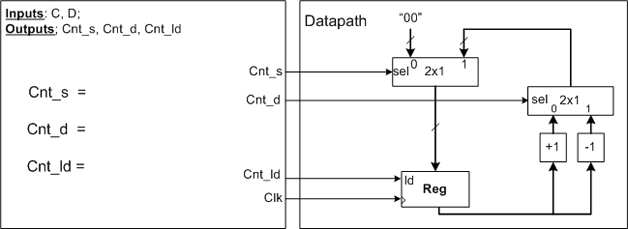
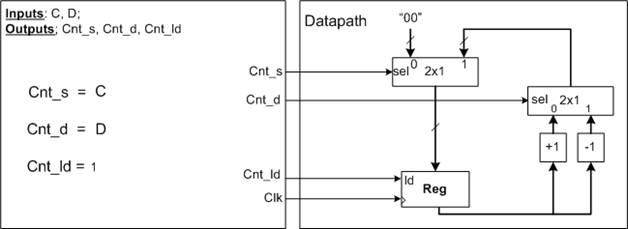
In the figure below, write Boolean expressions for the Cnt_s, Cnt_d and Cnt_ld so that the Datapath performs up and down counting. The counter counts upwards, downwards or not at all, as follows:
- when C='1' and D='0', it counts up
- when C='1' and D='1', it counts down
- when C='0', it stays at "00".
Solution
Detailed Explanation
View Video Explanation for Problem 1
Problem 2
Question
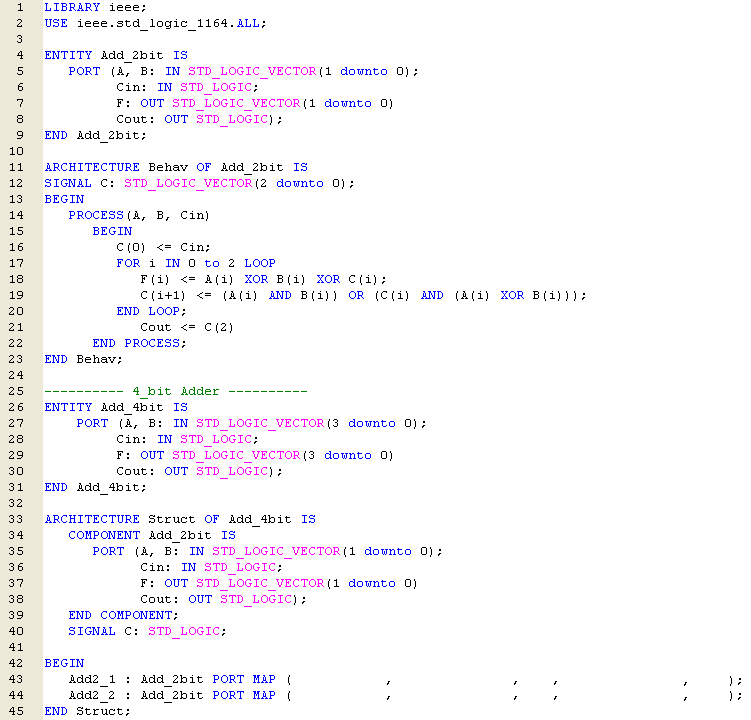
Complete the following VHDL code to implement a 4-bit FullAdder unit with data inputs A, B, Cin and outputs F and Cout using two 2-bit FullAdder units as components.
Solution
Line # Code 43 Add2_1 : Add_2bit PORT MAP (A(1 downto 0), B(1 downto 0), Cin, F(1 downto 0), C); 44 Add2_2 : Add_2bit PORT MAP (A(3 downto 2), B(3 downto 2), C, F(3 downto 2), Cout); Detailed Explanation
View Video Explanation for Problem 2
Sample Problem 3
Question
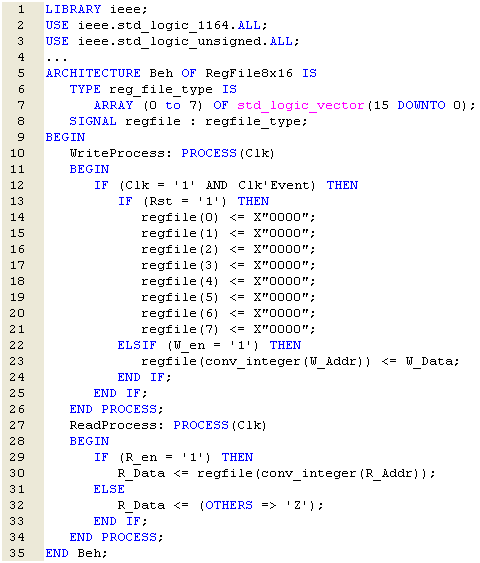
Fix the given code of the 8x16 register file so it models correctly the operation of a register file:
Solution
Line # Code 27 ReadProcess: PROCESS(R_Addr, R_en, regfile) Detailed Explanation
View Video Explanation for Problem 3
Sample Problem 4
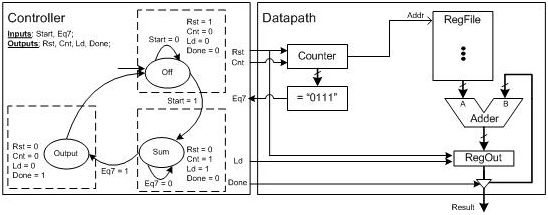
In the figure below, write the missing values for input and output control signals in the state machine of the Controller so that the entire design works as an accumulative sum function:
 ai The computation starts when control signal Start becomes '1' by moving from Off to Sum state. In state Sum, the Adder in the Datapath adds the numbers from the register file (RegFile) starting from address "0000" to address "0111", according to the values in the Counter. When control signal Eq7 becomes '1', the state machine goes to Output state where it outputs the content of the RegOut register for one clock cycle, after which it returns to the Off state.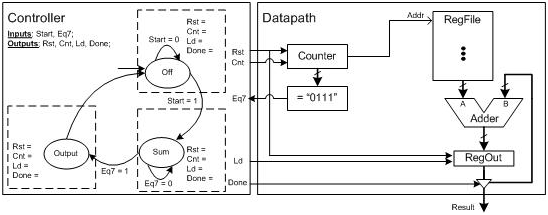
Solution
Detailed Explanation
View Video Explanation for Problem 4
Sample Problem 5
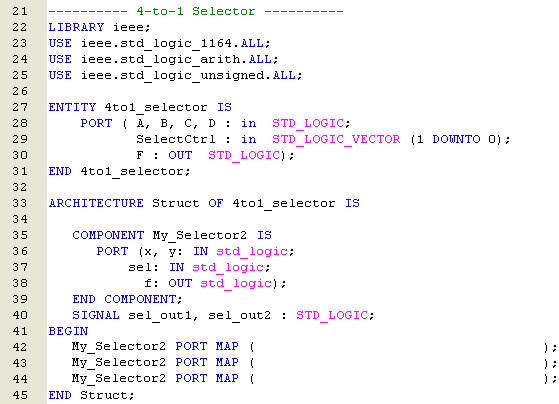
 Complete the following VHDL code to implement a 4-to-1 SELECTOR with data inputs A, B, C, D and a control input SelectCtrl using 2-to-1 SELECTORS as components. Table on the right shows functionality of 4-to-1 SELECTOR.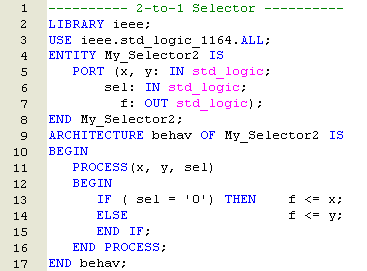
Solution
Line # Code 42 Sel1: My_Selector2 PORT MAP (A, B, SelectCtrl(0), sel_out1); 43 Sel2: My_Selector2 PORT MAP (C, D, SelectCtrl(0), sel_out2); 44 Sel3: My_Selector2 PORT MAP (sel_out1, sel_out2, SelectCtrl(1), F); Detailed Explanation