EECS 31L/CSE 31L: Lab 4 (Winter 2012)
IP Design Lecture Videos for Lab 4
- IP Concepts (pdf)
- IP Design (pdf)
- IP Structure (pdf)
Digital Design Example Video for Lab 4
- DCT Example: Overview, Behavior, Structure Datapath, and Structure Controller (pdf)
Lab 4 Handout
-
"; print ""; if ($auth_object->isLoggedIn()) { if ($auth_object->allowedAccess($auth_object->EECS31L_ARRAY)) { print "View Lab 4 Handout"; } else if ($auth_object->allowedAccess($auth_object->EECS31L_STUDENT_ARRAY)) { print "View Lab 4 Handout"; } else { print "View Lab 4 Handout (TBA)"; } print ""; } else { // you're not logged in, sorry... print "View Lab 4 Handout (TBA)"; } ?>
Digital Design Refresher for Lab 4
Available on EECS 31/CSE 31 Course Page
- RTL Storage Components
- C-to-RTL (Part 1)
Lab 4 Quiz Sample Problems
Problem 1
Question
The Design below executes the function F = a*b + c + d. The Datapath contains an ALU which can do either addition or multiplication in one clock cycle. Variables a, b, c, and d are stored in the 8 x 16 Register File, where any intermediate result can also be safely stored. Please describe the both non-pipelined and pipelined Datapath operation by specifying the value (expressed by a, b, c, and d) in Reg1, Reg2, and Reg3 for each clock cycle.


Solution

Detailed Explanation
View Video Explanation for Problem 1
Problem 2
Question
The following VHDL code for the 4-bit adder with carry (Add4wCarry) does not compile and simulate with ModelSim. Rewrite the minimum number of lines to make the entire code compile and simulate correctly.
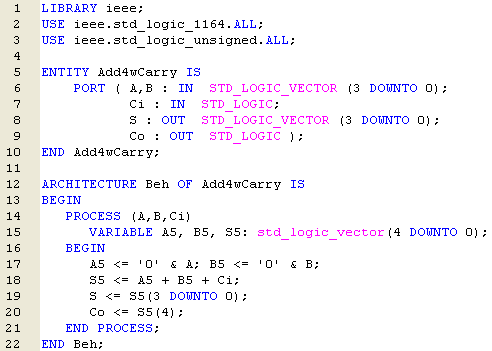
Solution
Line # Code 17 A5 := '0' & A; B5 := '0' & B; 18 S5 := A5 + B5 + Ci; Detailed Explanation
View Video Explanation for Problem 2
Problem 3
Question
The incomplete VHDL code below represents a Sum of Absolute Differences (SAD) component. Complete the VHDL code as described by the commented sections.
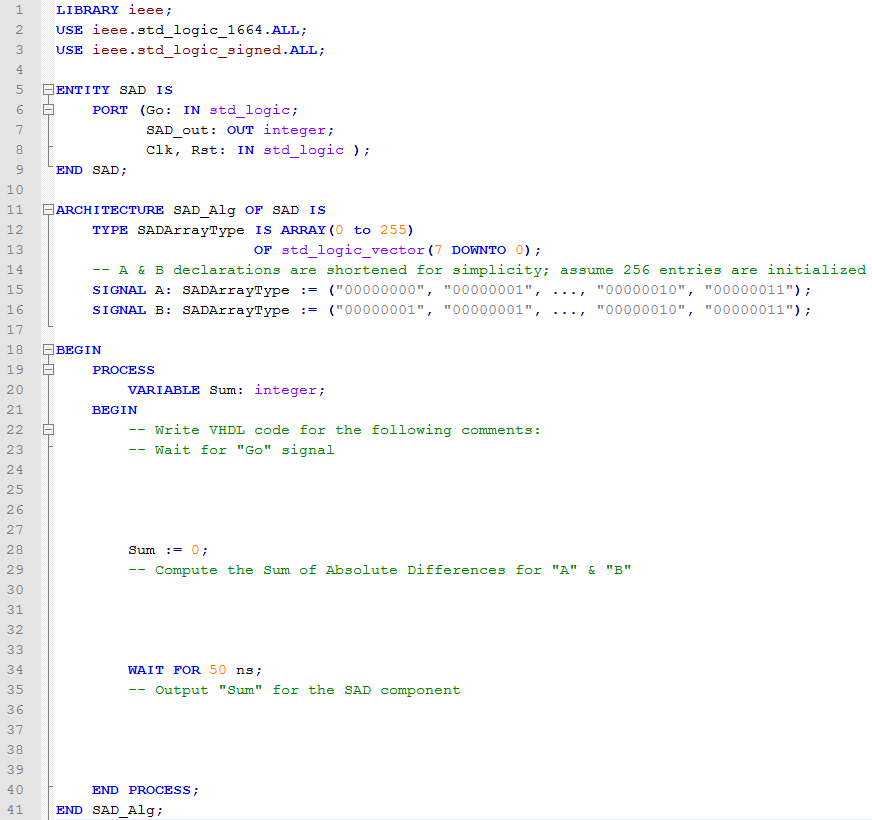
Solution
Line # Code 24 IF (NOT(Go = '1')) THEN 25 WAIT UNTIL Go = '1'; 26 END IF; 30 FOR I IN 0 TO 255 LOOP 31 Sum := Sum + Conv_Integer(ABS(A(I) - B(I))); 32 END LOOP; 36 SAD_out <= Sum; Detailed Explanation
View Video Explanation for Problem 3
Problem 4
Question
In the figure below, write the missing values for input control signals b and Eq2 and output control signals Ld and Sel in the state machine of the Controller so that the entire design works as a timer which starts when control signal b becomes '1' stays in On state for two Clk cycles while output x='1'. When control signal Eq2 becomes '1', the timer returns to Off state where it outputs x='0'.
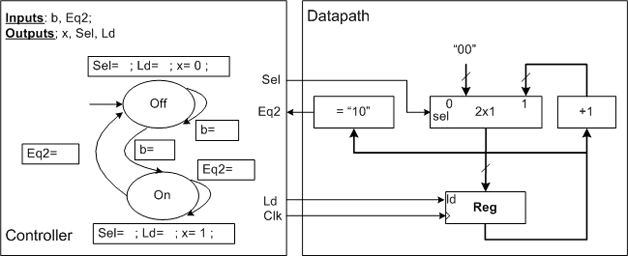
Solution
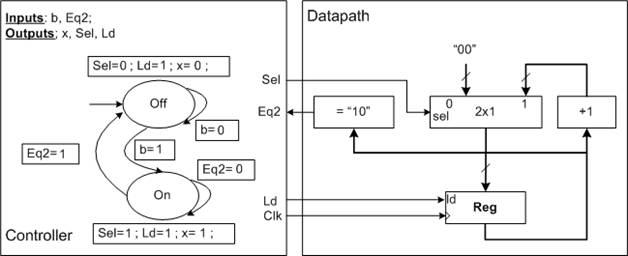
Detailed Explanation
View Video Explanation for Problem 4
Problem 5
Question
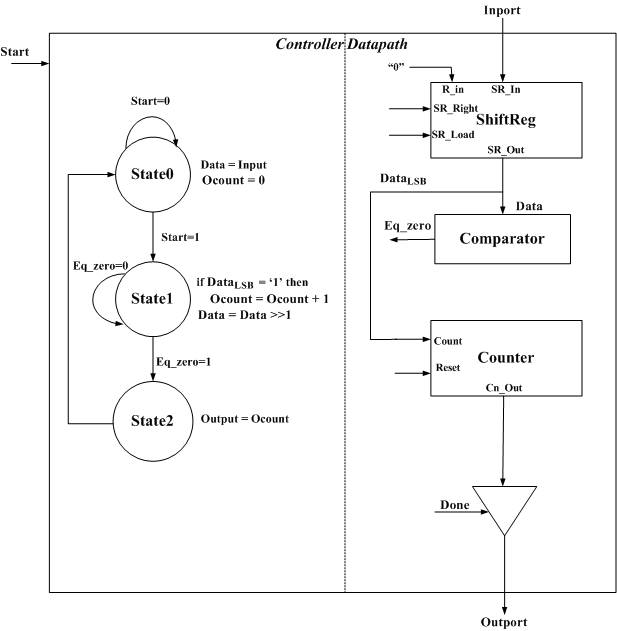
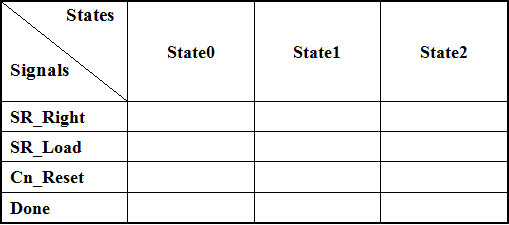
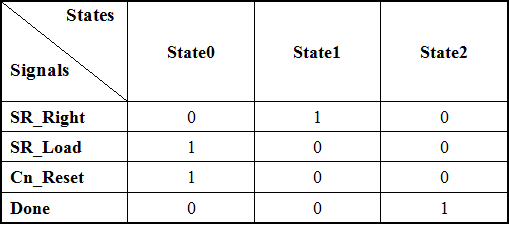
The IP design One's Counter (OC) counts the number of 1's in Data. OC's datapath consists of a ShiftReg which shifts data rightward when SR_Right = 1 and loads data when SR_Load = 1, a Counter which counts up when Cn_Count = 1 and resets when Cn_Reset = 1, and a Comparator which outputs 1 when Data value is 0. Complete the controller by specifying the value of 4 control signals SR_Right, SR_Load, Cn_Reset, and Done.
Solution
Detailed Explanation